
 By Backlinks Hub
Key Takeaways
- Shift to Active Pedagogy: Interactive math tools transition K-12 and undergraduate students away from passive, rote memorization toward dynamic, visual, and conceptual problem-solving models.
- Mitigating Learning Loss: According to empirical data from the National Assessment of Educational Progress (NAEP), targeted digital intervention and structured academic scaffolding are vital for closing achievement gaps in American schools.
- The Dual-Layer Support Framework: Gamified learning builds early numerical confidence, whereas advanced secondary and tertiary coursework requires structured, expert-led academic intervention to master multi-step logic.
- Data-Driven Personalization: Adaptive learning technologies supply real-time diagnostic feedback, empowering educators to tailor instruction dynamically to diverse student paces.
- Equity & Infrastructure: Bridging the digital divide requires equitable access to high-speed broadband, robust teacher training (TPACK model), and balanced blended-learning curricula.
The landscape of American education is undergoing a structural paradigm shift. Gone are the days when a static chalkboard, physical textbook, and repetitive drill worksheets served as the sole instruments for cultivating mathematical comprehension. Today’s classrooms across the United States—from suburban school districts in Illinois to urban public networks in New York and California—are dynamic, technology-infused ecosystems. In these modern environments, interactive math simulations, real-time gamification platforms, and specialized digital academic support systems work in concert to build analytical reasoning.
As educational standards evolve and digital integration becomes standard policy nationwide, educators, administrators, and policy experts face a critical mandate: closing persistent mathematical proficiency gaps while sustaining student engagement. Data published by the National Center for Education Statistics (NCES) underscores significant post-pandemic fluctuations in standardized assessment scores, accentuating an urgent need for versatile, evidence-based educational tools.
By strategically fusing interactive math resources with targeted academic guidance, American educators are not only modernizing foundational arithmetic instruction, but also constructing clear, sustainable pathways for long-term STEM (Science, Technology, Engineering, and Mathematics) achievement.
1. The Evolution of Math Instruction in US Classrooms
For over a century, traditional mathematics instruction in the United States adhered strictly to direct instruction models. In a conventional setting, an educator demonstrated a specific algorithm on the board, and students were expected to replicate the procedure across dozens of textbook problems. While this approach fostered basic procedural fluency, it frequently fell short of establishing deep visual intuition, spatial awareness, or conceptual problem-solving capabilities.
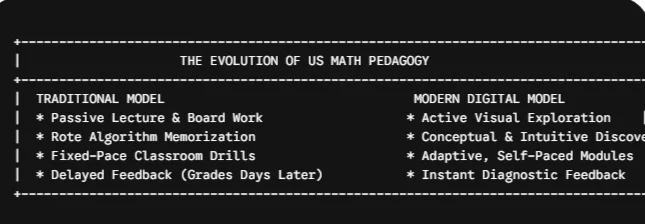
Modern educational technology frameworks actively shift the instructional focus toward active learning models. By leveraging dynamic digital tools, students can manipulate interactive visual fractions, graph non-linear functions instantaneously, and interact with three-dimensional geometric proofs. This pedagogical evolution directly confronts two of the most persistent hurdles in American mathematics education:
Mitigating Math Anxiety
Mathematics anxiety is a documented psychological barrier that affects millions of K-12 and college students across the United States. Traditional drill-and-practice environments often exacerbate stress by penalizing early errors heavily. Interactive math platforms convert problem-solving into an iterative, low-stakes discovery process. When a mistake occurs in a digital simulation, the system provides real-time visual feedback rather than a red mark on paper, encouraging students to analyze their error, adjust parameters, and try again without hesitation.
Accommodating Diverse Learning Velocities
In a standard 30-student classroom, students absorb mathematical concepts at vastly different rates. Linear textbook progression forces teachers to teach to the middle, leaving struggling students behind while failing to challenge advanced learners. Adaptive digital engines evaluate a student’s real-time accuracy and confidence levels, automatically adjusting problem complexity. Advanced students can stretch into enrichment topics, while peers needing reinforcement receive tailored scaffolding.
2. Interactive Tools vs. Structured Academic Support: A Dual-Layer Approach
While interactive games and visual software excel at building foundational intuition during elementary and middle school years (K-8), academic demands increase exponentially as students transition into high school AP courses and undergraduate programs. As simple arithmetic and basic algebra yield to multi-variable calculus, linear algebra, differential equations, and statistical modeling, open-ended visual software alone is no longer sufficient. Upper-level quantitative disciplines demand rigorous, structured problem-solving frameworks.

As coursework intensifies, American students frequently encounter complex theoretical applications that require dedicated guidance beyond standard classroom hours. When navigating challenging STEM assignments, students often reach out for comprehensive digital platforms, actively seeking reliable options to help me with my assignment when tackling rigorous academic deliverables. Bridging software-based interactive practice with expert academic guidance creates a continuous support continuum, ensuring students do not hit an academic ceiling when transitioning from basic conceptual play to advanced quantitative problem sets.
3. Core Pedagogical Benefits of Digital Math Integration
School districts across states like Texas, New York, Florida, and California that have systematically integrated digital learning infrastructure report significant structural benefits:
Visualizing Abstract Concepts
Mathematics is inherently abstract. Concepts such as vector spaces, complex numbers, or limits are difficult to communicate through text alone. Dynamic software tools translate abstract numerical relationships into clear, interactive diagrams. A student struggling with the concept of slope can adjust sliders in real time, watching how changes in variables instantaneously alter a graphed line.
Instantaneous Diagnostic Feedback Loops
In traditional homework assignments, a student might complete twenty problems incorrectly using a flawed method, only to discover the mistake days later when the paper is returned. Digital tools interrupt this pattern by offering immediate, line-by-line feedback. If a step is executed incorrectly, the software highlights the error instantly, enabling corrective learning before bad habits solidify.

Empowering Teachers with Actionable Data
Modern educational platforms automatically compile performance analytics into intuitive teacher dashboards. Instead of waiting for mid-term exams to gauge class comprehension, educators can review daily dashboards showing exactly which concepts (e.g., polynomial factoring vs. quadratic formulas) require whole-class review and which students require one-on-one intervention.
Enhancing Engagement Through Gamification
Gamification integrates game-design elements—such as points, achievement badges, leaderboards, and interactive quests—into educational activities. For younger learners, gamified math tools convert routine practice into an enjoyable challenge, increasing daily voluntary practice time outside of assigned school hours.
Universal 24/7 Academic Accessibility
Digital resources eliminate geographic and physical access barriers. Whether a student is studying late at night in a rural district or seeking help over the weekend in a major metro area, specialized academic resources like targeted Math Assignment Help provide round-the-clock problem-solving strategies, ensuring learning continues outside formal school hours.
4. The Lifecycle of Digital Math Learning in the US Education System
To understand how digital tools and academic support interact across a student’s educational trajectory, it is helpful to examine the continuum from primary school through higher education.

5. Overcoming Equity, Infrastructure, and Implementation Challenges
While the benefits of digital transformation are clear, real-world execution across the complex landscape of US public education presents several structural challenges that require deliberate policy and operational solutions.
Addressing the Digital Divide
The “digital divide” remains a major equity challenge in American education. High-speed fiber broadband and modern hardware are ubiquitous in wealthy suburban districts, but low-income urban schools and remote rural communities often experience limited connectivity and outdated hardware. True educational transformation requires targeted federal and state funding initiatives—such as the FCC’s E-Rate program—to ensure every student gains access to digital academic environments.

The TPACK Framework for Professional Teacher Development
Simply putting tablets on student desks does not improve learning outcomes. Without proper teacher training, digital devices can turn into expensive distractions. Leading US educational institutions utilize the TPACK (Technological Pedagogical Content Knowledge) framework to ensure technology integration is pedagogically sound:
Technological Knowledge (TK)
/ \
/ \
/ TP \
/ ACK \
/ Framework \
/————–\
Pedagogical Knowledge (PK) ———— Content Knowledge (CK)
- Content Knowledge (CK): Deep mastery of the underlying mathematical concepts being taught.
- Pedagogical Knowledge (PK): Understanding of effective teaching strategies, cognitive development, and classroom management.
- Technological Knowledge (TK): Technical fluency with software engines, interactive tools, and hardware interfaces.
True integration occurs only at the intersection of all three domains—where educators use technology specifically to enhance how mathematical content is delivered and understood.
Maintaining a Balanced Blended-Learning Curriculum
Over-reliance on digital screens can hinder spatial and fine-motor development in younger children. Expert educators advocate for a blended-learning model that balances physical, hands-on activities (such as pencil-and-paper proofs, ruler-and-compass constructions, and physical math blocks) with digital practice. Technology should enrich and expand human instruction, not replace physical problem-solving practice.
6. Real-World Case Studies: Digital Impact Across US Districts
Case Study A: Urban Middle School District in Ohio
An urban school district in Ohio integrated interactive graphing engines and real-time gamified practice across eight middle schools serving Title I populations. Over two academic years, the district monitored progress using standardized state assessment metrics:
- 8th Grade Algebra Readiness: Proficiency scores increased by 14.2% compared to historical baselines.
- Student Retention: Homework completion rates rose from 62% to 84% due to instant feedback features.
- Teacher Efficiency: Educators reported saving an average of 4.5 hours per week on routine grading, allowing them to redirect time toward small-group interventions.
Case Study B: Higher Education STEM Retention in Texas
A public university system in Texas faced high drop-out rates in freshman Calculus I and General Physics courses. By implementing structured digital academic assistance alongside traditional lectures, the department provided students with on-demand problem-solving resources and step-by-step guidance.
- D/F/Withdrawal (DFW) Rates: Dropped from 31% down to 18% over a three-semester evaluation window.
- Retention Rates: STEM major retention from freshman to sophomore year improved by 9.6%.
7. Comparative Analysis: Traditional vs. Tech-Enhanced Pedagogy
To quantify how digital integration updates standard classroom practices, consider the comparative structural breakdown below:

8. Emerging Trends Shaping the Future of US Math Education
As technology advances, several pioneering trends are poised to further transform American classrooms:
+———————————————————————————–+
| NEXT-GENERATION EDTECH TRENDS IN MATHEMATICS |
+———————————————————————————–+
| |
| [ AI Diagnostics ] ──► Predictive analytics that pinpoint precise learning gaps |
| |
| [ AR/VR Geometry ] ──► Immersive 3D environments for spatial proofs & vectors |
| |
| [ Gamified Coding] ──► Fusing Python/Scratch logic directly into math curricula |
| |
+———————————————————————————–+
AI-Driven Predictive Diagnostics
Artificial intelligence engines are evolving beyond basic adaptive questioning. Next-generation systems can analyze a student’s step-by-step work to pinpoint the exact conceptual misunderstanding—such as confusing negative sign operations during fraction division—and automatically generate targeted mini-lessons to correct the specific issue.
Immersive Augmented & Virtual Reality (AR/VR)
Virtual and augmented reality tools allow geometry and calculus students to step inside mathematical figures. Students can physically walk around a 3D parabolic surface, manipulate multi-dimensional vectors with hand gestures, or explore architectural applications of geometry in virtual space.
Integration of Computational Thinking and Coding
Modern US state standards increasingly blend mathematics with computer science. Digital math tools now frequently integrate basic block-based coding (such as Scratch) or text-based programming (such as Python). By writing code to generate mathematical patterns or simulate statistical distributions, students gain practical technical skills alongside core mathematical theory.
Frequently Asked Questions (FAQs)
How do interactive math tools improve student performance?
Interactive tools encourage active learning by converting abstract formulas into visual, dynamic representations. This visualization helps students construct an intuitive understanding of concepts, correct mistakes immediately via real-time feedback, and significantly lower math anxiety.
Are digital math tools designed to replace classroom teachers?
No. Digital software, interactive games, and online platforms are designed to supplement human instruction, not replace it. They automate routine administrative tracking, provide self-paced practice environments, and equip teachers with detailed performance analytics to deliver targeted, personalized instruction.
What is the difference between gamified math tools and structured academic support?
Gamified math tools use interactive play and visual software to teach foundational concepts (widely utilized in K-8 education). Structured academic support provides step-by-step analytical guidance and targeted problem-solving assistance for higher-level, complex coursework in high school and college.
How can school districts address the digital divide when launching new edtech programs?
Districts can address equity gaps by securing state and federal infrastructure grants, establishing 1:1 hardware initiatives (providing laptops or tablets to every student), partnering with local internet service providers for low-cost broadband, and selecting edtech platforms that offer robust offline accessibility features.
How does blended learning prevent screen fatigue in young math students?
Blended learning limits continuous screen time by balancing digital practice with hands-on physical activities, direct group discussions, paper-based proofs, and physical manipulatives. Screens are used strategically for dynamic visualization and practice, ensuring a balanced, healthy physical learning environment.
References & Scientific Data Sources
- National Center for Education Statistics (NCES): The Nation’s Report Card: Mathematics Assessments & Long-Term Trend Studies. US Department of Education.
- National Council of Teachers of Mathematics (NCTM): Principles to Actions: Ensuring Mathematical Success for All. NCTM Standards Publications.
- Journal of Educational Psychology: Meta-Analysis of the Impact of Computer-Assisted Instruction on K-12 Mathematics Achievement.
- Edutopia / George Lucas Educational Foundation: Integrating the TPACK Framework in K-12 STEM Classrooms.
Author Profile
Dr. Elizabeth Vance
Senior Educational Content Strategist & Academic Advisor at MyAssignmentHelp
Dr. Elizabeth Vance holds a Ph.D. in Mathematics Education from the University of Wisconsin-Madison and brings over 14 years of professional experience in curriculum design, STEM policy evaluation, and educational technology integration across US public and private school systems. As a Senior Content Strategist at MyAssignmentHelp, she specializes in creating innovative, research-backed instructional frameworks that bridge digital learning tools with structured academic support to help students achieve mastery across quantitative disciplines.