
 By Apex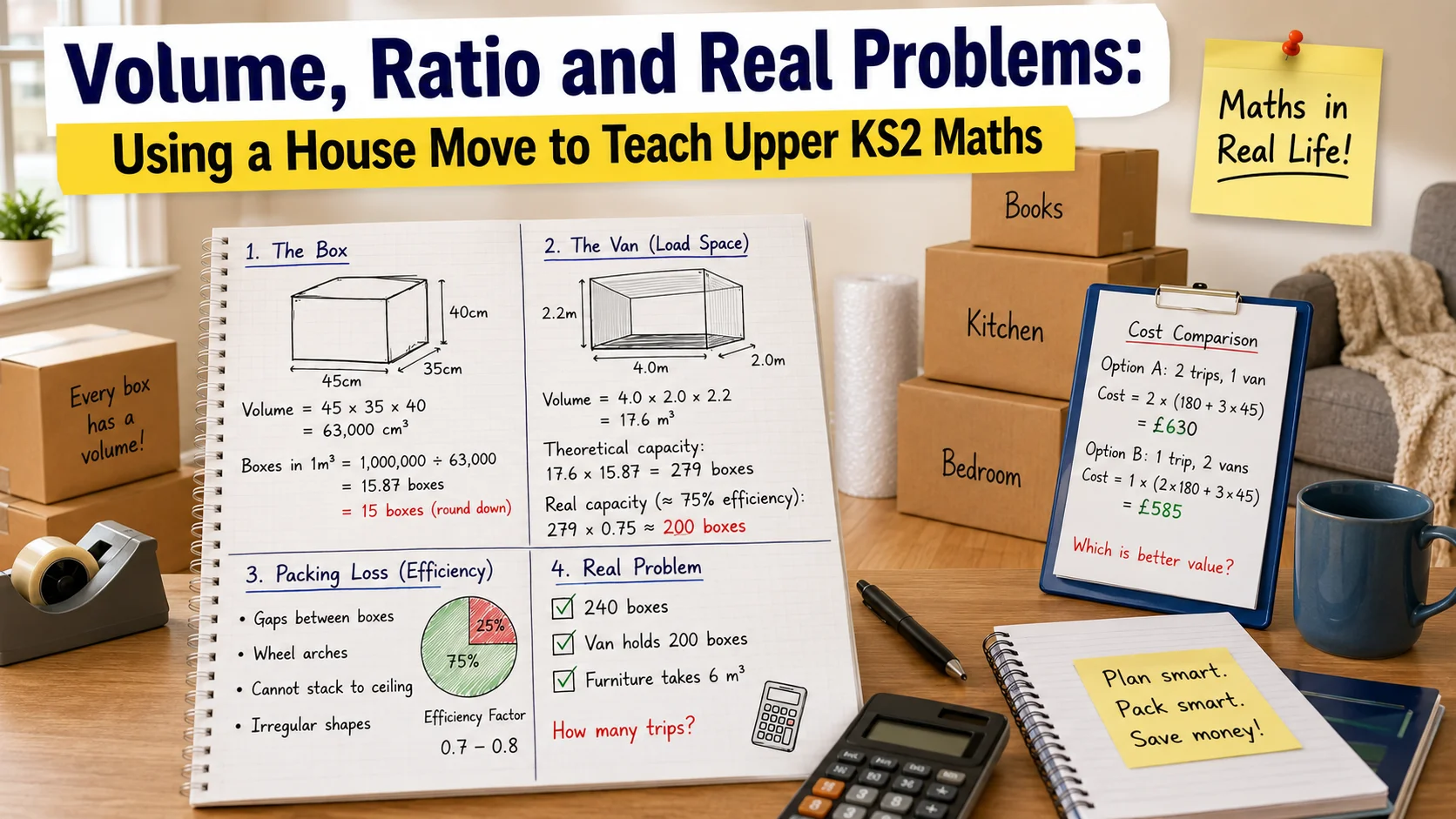
Every teacher of upper Key Stage 2 maths runs into the same wall with volume. Children can calculate the volume of a cuboid perfectly well on paper and still have no intuition for what 1.5 cubic metres actually looks like. The number is abstract. The unit is abstract. The whole topic floats free of anything they can picture.
One of the more effective contexts I have found for grounding it is a house move. It is familiar to most children, it generates genuinely messy numbers, and — usefully — it produces answers that can be wrong in interesting ways.
Why moving works as a context
Three reasons.
The units are real. Removal companies quote in cubic metres or cubic feet. Van capacities are published. Boxes come in standard sizes. Every number in the problem exists somewhere in the world outside the classroom.
The answer matters. If you underestimate, you need a second van. That has a cost, and the cost is easy to state. Children respond to problems where being wrong has a visible consequence.
It resists the standard method. The volume of your possessions is not the volume of the van you need, and working out why is where the actual mathematics lives.
Starting point: the box
Begin with a single removal box. The standard size used across the UK is roughly 45 cm × 35 cm × 40 cm.
Ask for the volume. Children will produce 63,000 cm³ and stop there, satisfied.
Then ask how many fit in a cubic metre.
This is where the lesson starts working. A cubic metre is 1,000,000 cm³. Divide and you get 15.87 boxes. The immediate question from at least one child is always the same: what does 0.87 of a box mean?
Nothing. That is the point. You round down to 15, and you have just introduced the idea that some real-world division problems can only round one way.
Second stage: the packing loss
Now give them the van.
A standard Luton van has a load space of about 4.0 m × 2.0 m × 2.2 m. Volume: 17.6 m³. At 15.87 boxes per cubic metre, that is 279 boxes.
Let them calculate it. Let them be pleased with it. Then tell them the real figure removal firms use is closer to 200.
The gap is the lesson. Where did 79 boxes go?
Children will suggest answers and most of them are correct:
- Boxes are rigid, so there are gaps between them and the curved walls
- The wheel arches intrude into the load space
- You cannot stack to the ceiling safely
- Not everything being moved is box-shaped
This introduces the idea of a packing efficiency factor. Real-world capacity is theoretical capacity multiplied by something between 0.7 and 0.8. It is a ratio problem hiding inside a volume problem, and it arrives naturally rather than being imposed.
Third stage: ratio and proportion
Once they have the efficiency factor, the extension work writes itself.
A family has 240 boxes. A Luton van holds 200. How many trips? — Two, and the second is mostly empty. Introduce the question of whether a smaller second van would cost less.
The same family has furniture as well, taking up 6 m³. Recalculate. — Now they are subtracting from capacity before dividing, which is a two-step problem with a real reason for the order of operations.
A move takes three hours per trip including loading. Each trip costs £180 plus £45 per hour. Compare two trips in one van against one trip in two vans. — Now it is a comparison problem with no single obvious answer, which is exactly the sort of thing that separates children who can calculate from children who can reason.
A note on where the real numbers come from
If you want authentic figures rather than invented ones, quote pages from removal firms are a useful source. They publish van dimensions, box counts and pricing structures, and the numbers are messy in the way that real numbers are. A firm handling student movers london work, for instance, will typically list what fits in each van size and what a single-room move actually requires — which turns out to be a far smaller number than most children guess, and generates a good discussion about why.
Using real published figures also sidesteps a problem with textbook questions, which is that the numbers are usually chosen to divide neatly. Real capacities do not divide neatly, and children need practice with the ones that do not.
Assessment ideas
The strongest assessment I have used is to give children a photograph of a room and a van specification and ask them to justify a recommendation. There is no single correct answer, but there are clearly wrong ones, and the reasoning is visible in a way that a numerical answer is not.
For lower-attaining groups, reduce it to boxes only and drop the efficiency factor. For higher attainers, add a weight constraint — vans have payload limits as well as volume limits, and books are heavy in a way that duvets are not. The moment weight enters, some children discover that the binding constraint has changed, and that is a genuinely sophisticated insight for Year 6.
Downloadable resources
The worksheet set covering box volume, van capacity and the packing efficiency extension is available in the resources section. The extension sheet includes the weight constraint variant.